
Spelling Quiz
🧒 For kids
- Look at the words. Only one is spelled right.
- Tap the right one.
- Wrong? Look at the underlined letters, then tap Next.
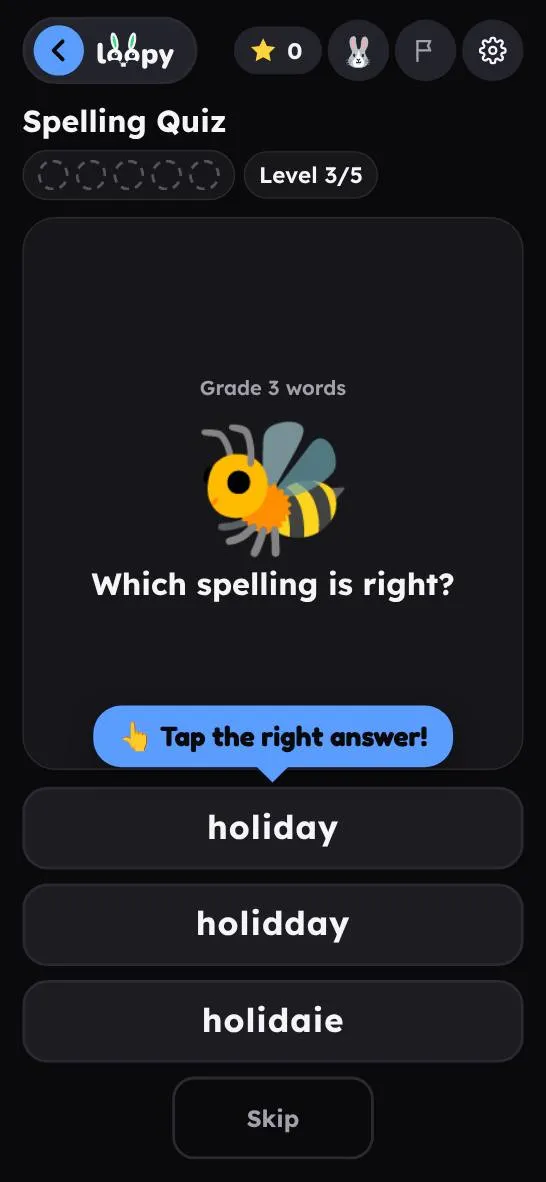
A spelling game for ages 6 to 12. Each question shows one word spelled 3 or 4 ways. Only one is right. A grown-up can type in the spelling words from school, and the wrong spellings are new every time.
How to play
Section titled “How to play”- Read the question: “Which spelling is right?” With Read aloud on, the game says the word. With a list from a grown-up, the card has no bee. It shows the word’s meaning under the question instead, when the list has one.
- Tap the word that is spelled right. Right: it turns green and you get a star.
- Wrong: your pick turns red and the right one turns green. The line shows the right spelling with the tricky part underlined, like “friend”.
- Tap Next for a new word.
On a keyboard, press 1 to 4 to pick a spelling, and Enter to go on.
Your own word list
Section titled “Your own word list”This part is for grown-ups.
- Open ⚙ Settings in the game and find Your word list.
- Type or paste the words, with commas between them:
friend, because, said, beautiful. - Tap Save list. The card now says “Your list · 4 words”.
- A meaning in brackets after a word shows under the question:
Biene (the bee), Wiese (the meadow). Up to 30 letters. loopy never looks a word up anywhere: the meaning comes from your list. - Up to 50 words, each 2 to 24 letters. “don’t” and “ice-cream” work too.
- The game says what it left out, like numbers or a typing mistake with @.
- Each child has their own list. There is one list for English and one for German: switch Words in to fill the other.
- Every word on the list comes once before any word comes back. A word missed before you loaded the list does not come back in Try again.
- Clear list goes back to loopy’s own words.
- The list stays in this browser. It moves to another device with the stars code.
New wrong spellings every time
Section titled “New wrong spellings every time”Each wrong spelling is the word with one mistake that children really make, picked at random. So “friend” can show as “freind” and “frend” one time, and “phriend” and “frend” the next.
- English: ie and ei, one letter or two (“necesary”), ph and f, c and k, silent letters (“nife”), endings like “-shun”.
- German: ie and i, ei and ai, one letter or two (“Namme”), the stretching h (“Zal”), ß and ss, ck and k, d and t at the end (“Hunt”), and a noun without its capital letter (“hund”).
A wrong spelling is never a real word from loopy’s lists or yours, and never a common look-alike like “their” for “there”.
Age levels
Section titled “Age levels”| Level | Age | Words | Spellings to pick from |
|---|---|---|---|
| 1 | 6 and under | Grade 1, like “said” | 3 |
| 2 | 7 | Grade 2, like “because” | 3 |
| 3 | 8 | Grade 3, like “believe” | 3 |
| 4 | 9 to 10 | Grade 4 to 5, like “separate” | 4 |
| 5 | 11 and up | Grade 6 and up, like “necessary” | 4 |
With your own list, the level only sets 3 or 4 spellings. After 10 right in a row, or 18 of the last 20 right, the game goes up a level by itself. After 3 wrong in the last 5 it offers an easier one. See Levels.
Settings
Section titled “Settings”Tap ⚙ Settings in the game to choose:
- Words in: English or Deutsch. The words follow loopy’s language. Pick the other one to practise it; the pick holds until loopy’s language changes.
- Your word list: see above.
- Level: the five levels above.
- Read aloud: says the word, in the language of the words. It is on by itself for ages 7 and under.
- Meaning under the question: On or Off. On at the start. Shows the meaning from your list, when a word has one.
- Print worksheet: 20 rows, each with the spellings of one word to circle, and its meaning when that is on. The answers are on page 2.
Example help text
Section titled “Example help text”- “Which spelling is right?”
- “Not quite. It is spelled friend.” with “ie” underlined.
- “Correct! because is spelled right.”
Something wrong?
Section titled “Something wrong?”Once in a while a made-up spelling can still be a real word. Tap the 🚩 flag at the top of the game to tell us. See Report a problem.