
Class Test
🧒 For kids
- The tasks come in the order of the test paper.
- Pick an answer, or type it and tap Check.
- After task 12 you see your points out of 20.
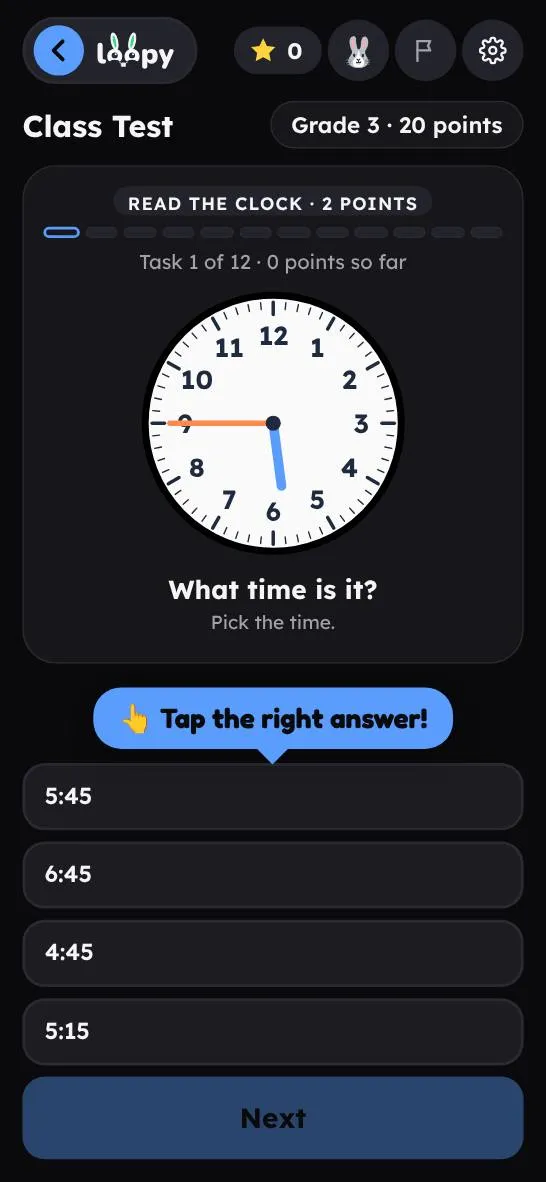
A maths test for ages 7 to 10, the way it comes at school. The 12 tasks follow a real grade 3 paper from Germany, task by task. Read the clock, read lines and dots, add and take away in steps. Giants and dwarfs, which way and why. Count money, is the money enough. The times table grid, and easy sums first. The points add up to 20 like the paper. The same test prints on paper for a pencil. A second paper, Addition to 100, follows the worksheet about the six ways to add.
How to play
Section titled “How to play”- The tasks come one after the other. The pill at the top says which task it is and how many points it is worth. The strip under it shows the 12 tasks: green for right, red for wrong, the blue one is on now.
- Pick an answer, or type it and tap Check. Some tasks have two parts, like the dwarf (68 − 5) and the giant (68 − 50).
- After each answer the line under the task says why.
- Tap Next for the next task.
- After task 12 the results card says the points out of 20, the best so far, and which game to practise next.
On a keyboard, 1 to 4 pick an answer, the digits type, Backspace erases and Enter checks or goes on.
The tasks
Section titled “The tasks”| # | Task | From the game | Points |
|---|---|---|---|
| 1 | Read the clock | What Time Is It? | 2 |
| 2 | Lines and dots | Tens and Ones | 2 |
| 3 | To the ten: 57 + 6 | Step by Step | 1 |
| 4 | Place by place: 25 + 43 | Step by Step | 1 |
| 5 | Giants and dwarfs: 68 − 5 and 68 − 50 | Tens and Ones | 1 + 1 |
| 6 | Help with 10: 35 − 9 | Step by Step | 1 |
| 7 | Take away in steps: 98 − 57 | Step by Step | 2 |
| 8 | Which way is this, and why | Which Way? | 1 + 1 |
| 9 | How much money: notes and coins, each with its € sign | Is It Enough? | 1 |
| 10 | Is the money enough | Is It Enough? | 2 |
| 11 | Times table grid | Times Table Grid | 1 + 1 |
| 12 | Easy sums first: 7 × 4 from 5 × 4 and 2 × 4 | Times Table Grid | 1 + 1 |
There are no levels. The test is the same for every age, like at school, and the numbers are new every time.
The second paper: Addition to 100
Section titled “The second paper: Addition to 100”Tap ⚙ Settings, then Paper, and pick Addition to 100. It follows the grade 3 worksheet about the six ways to add, task by task: 11 tasks, 25 points.
| # | Task | What to do | Points |
|---|---|---|---|
| 1 | 👫 Giants and dwarfs: 32 + 4 | 2 + 4 = 6 first, then the whole sum | 2 |
| 2 | 💞 To the ten: 38 + 5 | 38 + 2 = 40, then 40 + 3 | 2 |
| 3 | 🔟 Help with 10: 23 + 9 | 23 + 10 = 33, then 33 − 1 | 2 |
| 4 | How do you work it out? | Three sums like 56 + 9. Pick 1, 2 or 3 for the way | 3 |
| 5 | Make your own sum | “43 + ?” for each way: which second number fits | 3 |
| 6 | 🧮 Place by place: 24 + 33 | 20 + 30, 4 + 3, 50 + 7 | 3 |
| 7 | 🪜 Tens first: 49 + 25 | 49 + 20 = 69, then 69 + 5 | 2 |
| 8 | Jumps on the number line | The sum drawn as +20 and +5. Where does each jump land? | 2 |
| 9 | Helper sum first: 24 + 19 | 24 + 20 = 44, then 1 less | 2 |
| 10 | 🛟 Nearly round: 23 + 29 | 23 + 30 = 53, then 53 − 1 | 2 |
| 11 | Which way helps you with 57 + 39? | Pick the way, then work it out | 2 |
The ways are the ones from Step by Step and Which Way?. The paper is remembered for the child, and each paper keeps its own best score.
When an answer is wrong
Section titled “When an answer is wrong”The child has one try. A wrong answer turns red and the right one green. A typed number is crossed out instead. The line says the right one first: “Not quite. The answer is 33. Only the tens change: 4 tens − 1 ten = 3 tens, so 33.”
A right answer earns a star. A task that went wrong comes back in Try again. In the next test it takes the place of the fresh task of that kind. It stays until it is answered right twice. See Try again.
Settings
Section titled “Settings”Tap ⚙ Settings in the game to choose:
- Paper: Grade 3 test or Addition to 100.
- Read aloud: a speaker button on the card reads the task and the question out loud. It is on by itself for ages 5 to 7.
- Print the test: the same tasks on paper, 4 across, each with its points. The answers are on page 2. The results card has the same button. With Addition to 100 the six ways stand at the top of the sheet, with an example each.
Something wrong?
Section titled “Something wrong?”Tap the 🚩 flag at the top of the game to tell us. See Report a problem.