
Bigger or Smaller
🧒 For kids
- Look at the numbers.
- Tap the right sign or number.
- Look at the number line. Tap Next.
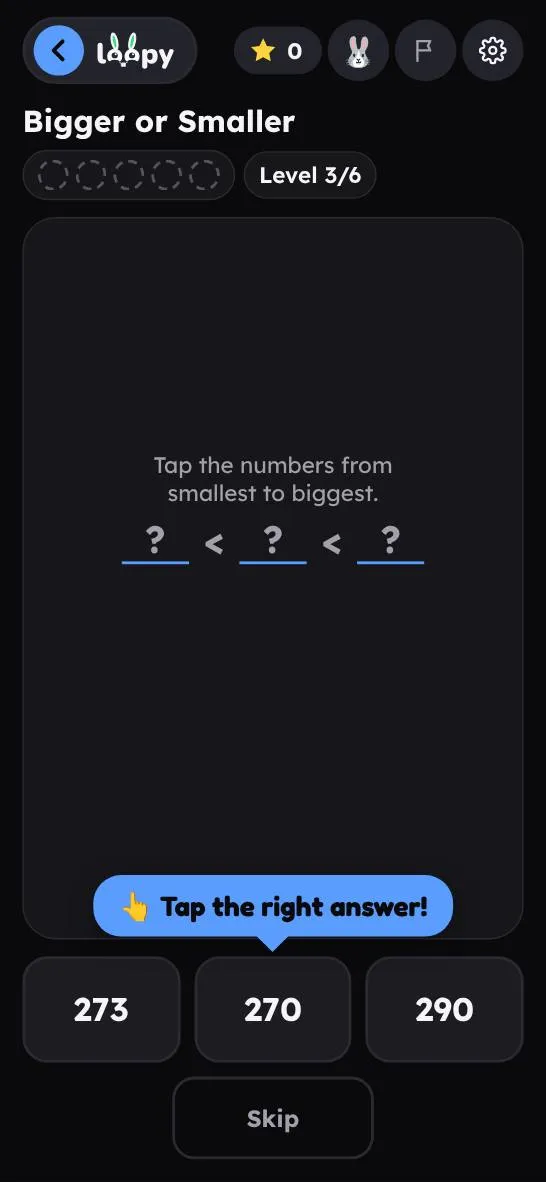
Compare numbers, put them in order and round them. After each answer, a number line shows where the numbers are. Many numbers look alike on purpose, like 37 and 73. That is where kids slip.
How to play
Section titled “How to play”There are three kinds of problems:
- Compare: two numbers with a circle between them, like 37 ◯ 73. Tap the sign that goes in the circle. The buttons say smaller, equal and bigger.
- Order: three numbers. Tap them from the smallest to the biggest.
- Round: one number, like 4,567. Round it to the nearest ten, hundred or thousand. Tap the right answer.
Then read the short reason and tap Next. Before you answer, the button says Skip. Tap it to get a new problem.
On a keyboard, press 1 to 4 to pick an answer. When comparing, the sign keys work too. Press Enter to go on.
At the top, Last 5 shows the last 5 answers as dots: green for right, red for wrong.
The number line
Section titled “The number line”The number line comes up after each answer, so it never gives the answer away.
- Compare and Order: each number is a colored dot. The smaller number is further left.
- Round: the line goes from the ten (or hundred, or thousand) below to the one above. A dashed line marks halfway. An arrow shows which way the number rounds.
When an answer is wrong
Section titled “When an answer is wrong”The right answer turns green and your pick turns red. In Order, a wrong tap ends the problem and the right order shows. The game says “Not quite.” and explains the answer. Then tap Next.
With small numbers, a wrong compare also says: “The open side of the sign faces the bigger number.”
Each right answer gives a star. A missed problem comes back later, and it shows in Try again on the home page. See Try again.
Age levels
Section titled “Age levels”| Level | Age | Numbers | Rounding |
|---|---|---|---|
| 1 | 6 and under | Up to 20, compare only | To the nearest ten |
| 2 | 7 | Up to 100 | To the nearest ten |
| 3 | 8 | Up to 1,000 | To the nearest ten or hundred |
| 4 | 9 | Up to 10,000 | To the nearest ten, hundred or thousand |
| 5 | 10 | Up to 100,000 | To the nearest hundred, thousand or ten thousand |
| 6 | 11 and up | Decimals like 0.5 and 0.45, minus numbers like −7, and numbers up to a million | Decimals to a whole number, big numbers to the nearest thousand |
From age 7, Mix gives all kinds together. Rounding joins the mix at 1,000.
After 10 right in a row, or 18 of the last 20 right, the game goes up a level by itself. After 3 wrong in the last 5 it offers an easier one. See Levels.
Settings
Section titled “Settings”Tap ⚙ Settings in the game to choose:
- Problems: Compare, Order, Round or Mix.
- Numbers: Up to 20, Up to 100, Up to 1,000, Up to 10,000, Up to 100,000 or Decimals and minus.
- Read aloud: a speaker button reads the question out loud, like “Is 37 smaller than, equal to, or bigger than 73?”.
- Print worksheet: 20 problems on a page, with the answers on page 2.
- Reset score: clears the score and the Last 5 dots.
Settings are kept for each age.
Example help text
Section titled “Example help text”- “73 has 2 digits and 9 has 1. More digits means bigger.”
- “Both have 4 digits. Compare the tens: 2 is more than 1, so 4,521 is bigger.”
- “Give both the same number of places after the point: 0.50 and 0.45. Now you can see 0.50 is bigger.”
- “−3 is closer to 0. With minus numbers, closer to 0 means bigger.”
- “4,567 is between 4,500 and 4,600. It is past halfway (4,550), so it rounds up to 4,600.”
Something wrong?
Section titled “Something wrong?”Tap the 🚩 flag at the top of the game to tell us. On a small screen, find Report a problem in ⚙ Settings. See Report a problem.