
Shapes and Angles
🧒 For kids
- Look at the drawing and read the question.
- Tap the answer you think is right.
- Read why. Then tap Next.
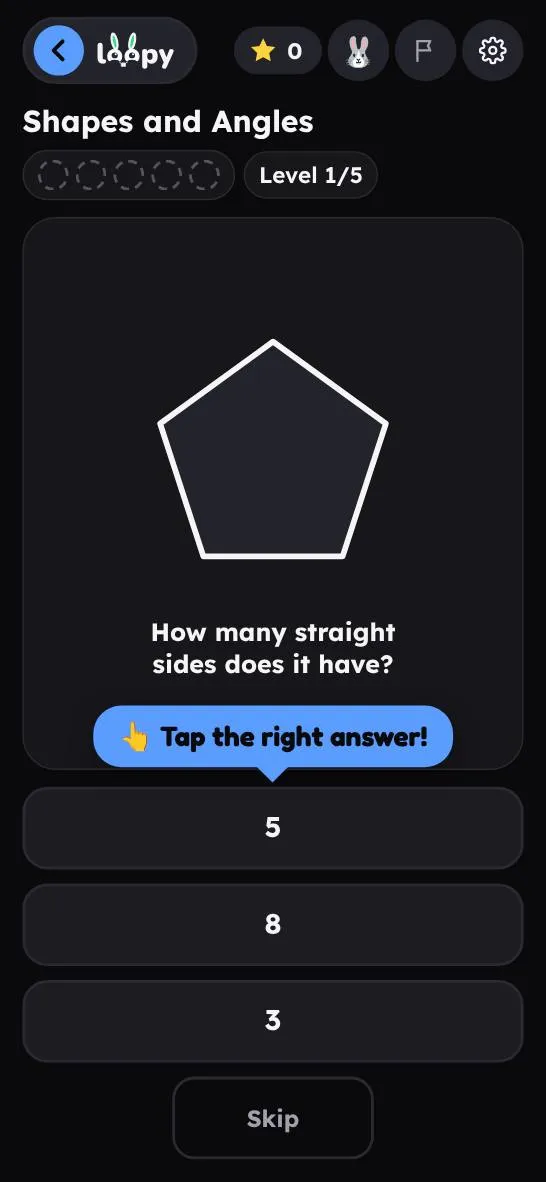
A geometry game with drawings, for ages 7 to 14. The child sees a shape, two lines, a grid or an angle. One question goes with it, like “Which shape is this?”, “Is the dashed line a line of symmetry?” or “What is the area?”. The child picks the answer. After each answer, one line says why.
How to play
Section titled “How to play”- Look at the drawing and the question under it.
- Tap the answer you think is right. The right one turns green.
- One line says why, like “A pentagon has 5 sides and 5 corners.”
- Tap Next for a new question. Not sure? Skip gives a new one.
Level 1 picks from 3 answers. The other levels pick from 4. Yes or no questions have 2.
On a keyboard, press 1 to 4 to pick an answer and Enter to go on.
Every drawing is made on the device and drawn to scale. An angle of 120° really is 120°. A rectangle on the grid really is 4 by 3 squares. Equal sides of a triangle get a small mark, and a right angle gets the little square.
When an answer is wrong
Section titled “When an answer is wrong”There is one try. The wrong answer turns red and the right one turns green. The line gives the right answer first, then why, like “Not quite. The answer is: 12 cm². 3 rows of 4 squares: 4 × 3 = 12 cm².”
A right answer gives a star. A missed question comes back later in Try again.
Age levels
Section titled “Age levels”| Level | Age | What comes up |
|---|---|---|
| 1 | 7 to 8 | Shapes, corners and sides: triangle, square, rectangle, circle, oval, pentagon and hexagon. Which shape is this? How many corners, how many straight sides? |
| 2 | 9 | Lines and symmetry: how many right angles? Are two lines parallel, perpendicular or crossing at a slant? Is the dashed line a line of symmetry, and how many lines of symmetry are there? Naming adds octagon, rhombus, trapezium, parallelogram and kite |
| 3 | 10 | Perimeter and area on squared paper: count the squares, go round the edge. Then a rectangle with a corner cut out |
| 4 | 11 to 12 | Angles: acute, right, obtuse, straight or reflex? About how big is it? Angles on a straight line make 180°, in a right angle 90° |
| 5 | 13 and up | Triangles and formulas: equilateral, isosceles, scalene or right-angled? The missing angle in a triangle or a quadrilateral. Area of a triangle, area and perimeter of a rectangle from its side lengths |
About one question in five comes from the level below, so what the child learned before stays fresh.
After 10 right in a row, or 18 of the last 20 right, the game goes up a level by itself. After 3 wrong in the last 5 it offers an easier one. See Levels.
Settings
Section titled “Settings”Tap ⚙ Settings in the game to choose:
- Level: Shapes, corners and sides, Lines and symmetry, Perimeter and area, Angles or Triangles and formulas. These are the five levels above.
- Read aloud: a speaker button on the card reads the question and the answers out loud. It is on by itself for ages 7 and under.
- Print worksheet: 20 drawings with the answers to circle. The answers are on page 2. The drawings print black on white, whatever the theme.
Tips for grown-ups
Section titled “Tips for grown-ups”- Spot shapes at home: how many corners has the table, the window, the clock?
- Fold a paper shape in half to test a line of symmetry. Try a rectangle along its diagonal: the corners stick out.
- Compare every angle with the corner of a sheet of paper. That corner is 90°.
- Say the rules out loud together: the angles of a triangle make 180°, and the area of a triangle is base times height, halved.
Example help text
Section titled “Example help text”- “Which shape is this? Triangle, square or pentagon?”
- “Correct! A hexagon has 6 sides and 6 corners, like a honeycomb cell.”
- “Not quite. The answer is: Obtuse. This angle is 120°. Between 90° and 180° is obtuse.”
- “The 3 angles of a triangle add up to 180°. 180 − 50 − 60 = 70.”
Something wrong?
Section titled “Something wrong?”Tap the 🚩 flag at the top of the game to tell us. See Report a problem.